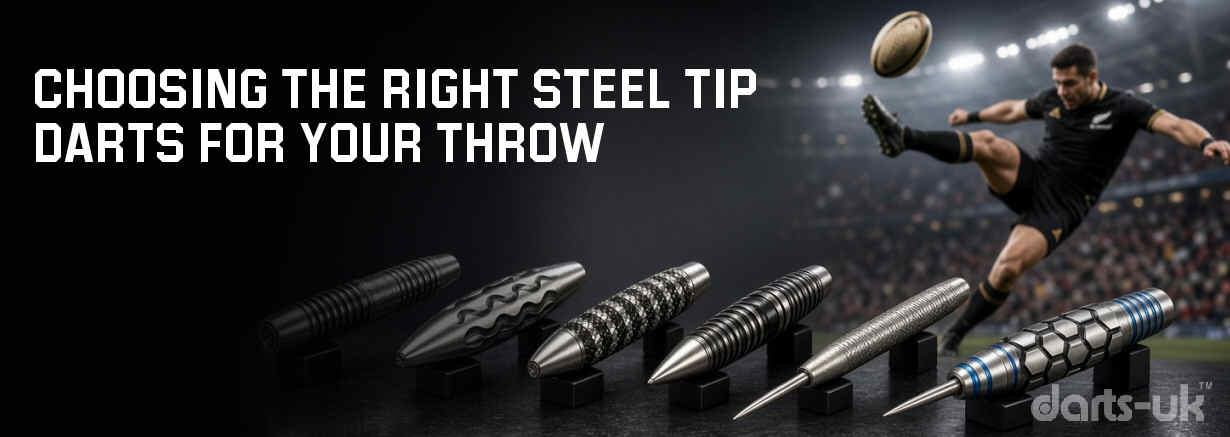
Choosing the Right Steel Tip Darts for Your Throw
At most league nights, there's at least one player with a set of darts sitting unused in a drawer at home, bought on a whim and barely thrown. The problem usually started at the shop. The box had a favourite player's name on it, the price looked right, or the barrel just looked good. A name on the packaging won't help much once the dart is in someone's fingers at the oche. Sets differ massively in weight, shape and grip. One player's favourite set can feel awful in a teammate's hand.
The smarter route is learning what the barrel, shaft and flight each do. After that, picking a set gets a lot easier. Grip is a good place to start. Some players hold the dart right up near the point and push it at the board. Others hold it further back and let it go with a long, loose follow-through. Both styles work. What matters is being able to repeat the same throw every time, and that's true of any precision skill in sport.
Rugby goal-kicking is a good example. Top kickers go through the same routine before every conversion or penalty, because a repeatable action holds up best under pressure. A kicker's accuracy is also something followers of rugby betting pay close attention to, since one missed kick can swing a close match. That's especially true of handicap bets, one of the most popular rugby markets, where a single three-point penalty can decide whether a bet wins or loses. Darts is no different. With the right set, repeating that throw dart after dart stops being such a fight.
Start With Weight
Weight is usually the first thing players check, and the rules allow far more than most people use. Under World Darts Federation rules, a dart can weigh up to 50 grams and be up to 30.5 cm (12 inches) long. Hardly anyone goes near that. The usual range is 20g to 26g. Only a small number of professionals go much lighter or heavier.
Extra weight tends to keep a dart on its line. Release it slightly wrong and it'll often still land close. Lighter ones react more to small changes in the throw. A few players like that. Plenty don't. For a first proper set, 22g to 24g sits right in the middle and rarely goes badly wrong. After a few weeks, it's usually obvious whether to go a gram or two up or down.
Barrel Material and Shape
The barrel is where the fingers go. What it's made from changes how fat it is, often more than people realise.
Brass costs the least. It isn't very dense, though, so a brass barrel ends up quite thick. Brass sets are fine for a first go or a spare set at home. Nickel-silver is a little denser and harder wearing, while still being affordable.
Tungsten is the material most serious players end up with. It's roughly twice as dense as brass, so a tungsten barrel can be a lot slimmer for the same weight. That matters in a crowded treble 20, where a fat barrel can block the second or third dart. Tungsten sets come labelled with a percentage, normally between 80% and 95%. The higher the number, the slimmer the barrel tends to be. And the dearer.
Shape decides where the weight sits. On a straight barrel, the weight is spread evenly along the length, which suits a grip that wanders a bit between throws. Torpedo barrels bulge towards the front and put more weight near the point. They tend to suit players who hold the dart close to the tip. Players who grip further back usually get on better with a more central balance.
Grip, Shafts and Flights
Grip means the pattern cut into the barrel. Fine knurling or light rings hold gently and let go cleanly. Deeper rings and sharp "shark fin" cuts bite harder. Handy late on a long league night, when fingers start to sweat. Too much bite causes its own problem, mind. A barrel that grabs the fingers can snag on the way out and drag the dart off line.
Shafts and flights are cheap. A pack costs a few quid, so swapping them around is the easy bit. Short shafts generally suit a compact, fingertip throw. Medium and long shafts give a bit more stability to a slower, loopier throw. Flights are similar. The standard shape is the biggest of the usual options. It catches more air and keeps the dart steady. Slim and kite flights are smaller, cut through the air quicker and tend to suit a flat, hard throw. A handful of cheap combinations and one evening at the board usually sorts it out.
Testing Before Committing
The best way to find the right darts is to throw as many different sets as possible. Borrowing a few from teammates and trying the tester sets that many specialist shops keep are both good options, ideally with at least a few legs thrown with each. Grouping, meaning how close the three darts land to each other, is a better guide than the score. A tight group in the wrong bed is easy to fix with practice, while a scattered group usually means the dart doesn't suit the thrower.
The test has to be fair, too. A board hung a few inches out, or an oche marked in the wrong spot, quietly changes the throw. Then the darts take the blame for it. Measuring once, to make sure the board is set up to the correct height and distance, saves hours of pointless testing.
Once a set clicks, leave it alone. Players who chop and change every few weeks rarely give their throw a chance to settle. A new set needs a couple of months of proper practice before it can be judged, because doubles and finishing combinations take a while to bed in. New darts won't turn a pub player into a county player overnight, but they do take one more variable out of the throw.