Setting Up Your First Dartboard at Home: Height, Distance and Lighting Done Right
Every new player remembers the moment the dartboard arrives. You tear open the box and then realise you have no real idea where it should go. Hang it by eye, and you could spend months practising at the wrong height, building habits that fall apart the first time you step up to a regulation board at the pub.
Getting the setup right from day one takes an extra half hour, and it saves a great deal of frustration later. The good news is that the official measurements are simple. Once you know them, the rest comes down to common sense and a decent tape measure.
How to Choose the Best Place for a Dartboard at Home
Before you reach for the drill, think about space. You need a clear run of roughly three metres from the wall to where you'll stand, with a little extra behind you for anyone waiting their turn. Width matters just as much. Aim for about a metre of clear wall on either side of the board, because stray darts have a remarkable talent for finding the one thing you'd rather they didn't.
Hallways look tempting but rarely work, since someone will inevitably wander through mid-throw. Garages and spare rooms tend to be the favourites. If you're using a living area, keep the board well away from doors and anything fragile, and check whether the dog's bed sits in the firing line.
For those who enjoy following other sports in their spare time, digital resources such as a bet builder calculator can also provide a useful way to understand how different sporting selections combine to produce overall odds.
Official Dartboard Height: Where the Bullseye Should Sit
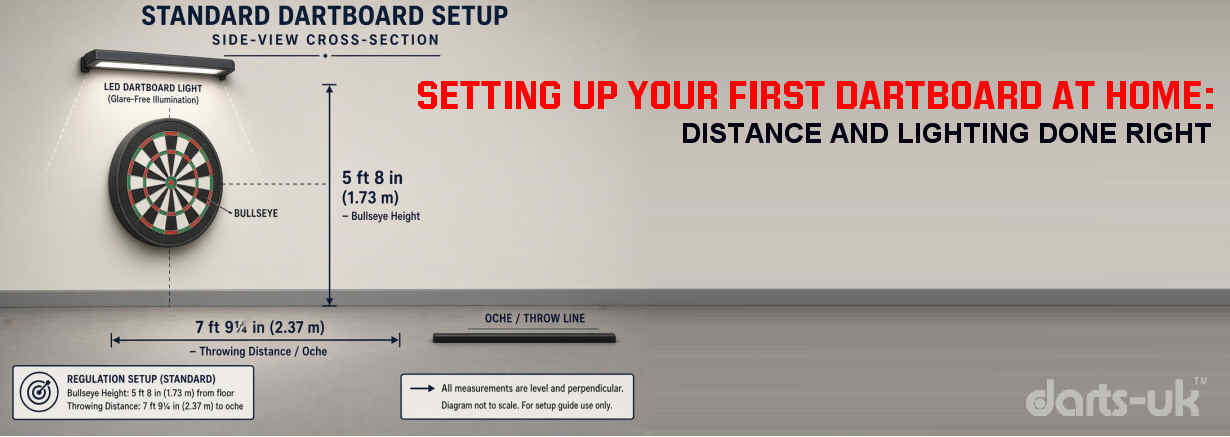
The centre of the bullseye should sit exactly 1.73 metres (5 feet 8 inches) from the floor. This is the regulation height used in professional and amateur play alike, and it applies whether you're 5 feet tall or well over 6.
The most common beginner mistake is measuring to the top of the board or to the mounting bracket. Always measure to the very centre of the bull. Most boards have a central bracket fixed to the back, so work out where the bull will land, mark that point on the wall and fit the bracket accordingly. Make sure the 20 segment sits at the top, usually in the darker colour. A board that wobbles will bounce darts straight out, so tighten everything firmly before you throw.
Dartboard Throwing Distance and How to Mark the Oche
For steel tip darts, the oche (the line you throw from) sits 2.37 metres (7 feet 9¼ inches) from the face of the board, measured along the floor. Note that it's the face of the board, not the wall. A standard bristle board is around 4 centimetres deep, so measuring from the wall leaves you slightly too close.
To double check your work, measure diagonally from the centre of the bullseye down to the oche at floor level. That distance should be 2.93 metres (9 feet 7⅜ inches). When both figures match, your height and distance are spot on.
If you play soft tip darts on an electronic board, the throwing distance is often 2.44 metres (8 feet), so check the manufacturer's guidance. A strip of tape will do as a marker, although a raised oche bar is better because you can feel it with your toe and it won't peel away after a few weeks.
Standard Dartboard Set-up (Side View)
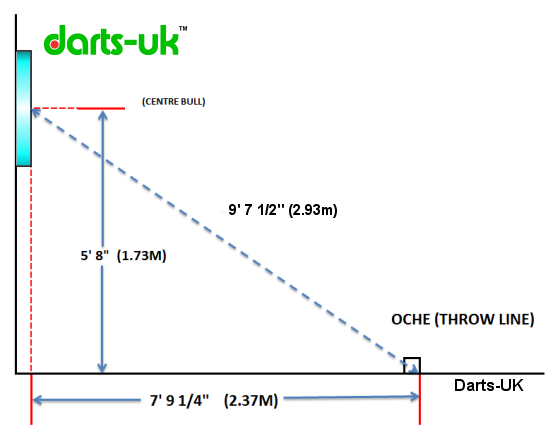
Standard Dartboard Set-up (Front View)

Dartboard Lighting: How to Avoid Shadows on the Board
Poor lighting is the setup problem most people overlook. A ceiling light behind you will throw your own shadow across the board, while a light directly above casts shadows from the darts already sitting in it, hiding the very segments you're aiming for.
The simplest fix is an LED ring light that fits around the board. It lights the playing area evenly from every angle, so shadows all but disappear. If you'd rather not buy one, a spotlight mounted above and slightly in front of the board works well, as long as it's angled away from your eyes. Avoid setting up opposite a bright window too. Squinting into the afternoon sun is no way to find double 16.
Protecting Your Walls and Floor from Stray Darts
Even good players miss the board now and then, and beginners miss it a lot. A dartboard surround is a padded ring that fits around the board and catches wayward darts before they reach the plaster. Alternatively, a dartboard cabinet gives you a backboard plus doors that close over the board when it's not in use, which tends to go down well in a shared living room.
Floors deserve attention too. Darts bouncing out of the dartboard will dent laminate and mark floorboards in no time. A throwing mat solves this neatly, and many have the oche distance printed on them, which saves you the job of marking it yourself.
Final Dartboard Setup Checks Before Your First Throw
Once everything is fixed in place, measure the height and distance one more time. It's surprisingly easy to end up a centimetre or two out, and that small error will follow you every time you play somewhere else.
It's also worth rotating your board every few weeks if it has a removable number ring. Players hit the 20 far more than anywhere else, so turning the board spreads the wear and gives the sisal fibres time to close up. Ignore any old advice about soaking a bristle board in water, as it makes the fibres swell and shortens the board's life considerably.
With the measurements right and the lighting sorted, all that's left is practice. Your board at home will feel just like the one at the club, and that consistency is what turns casual throwers into genuinely good players.